Spiral Con 2


SCHEDULE

Date and Location: Saturday, July 15th at the Freeman Center, Christopher Newport University, in Newport News, Virginia.

Overview: SpiralCon is a not-for-profit, academic fan convention celebrating the genres of the unreal: science fiction, fantasy, and supernatural horror. It is organized by Spiral Tower Press, a small independent amateur press that publishes three free e-zines: Whetstone: Amateur Magazine of Sword and Sorcery, Witch House: Amateur Magazine of Cosmic Horror, and Way Stayion: Amateur Magazine of Space OperaSpiralCon is a recreational enterprise meant to inspire intellectual discussion of pulp fiction and popular culture.

Scope: SpiralCon is a one day regional convention that begins at 8am and ends at approximately 6pm. It is uncatered and the guest speakers do not receive financial remuneration for their appearances. It is held in two rooms in the Freeman Center at Christopher Newport University. One room will be dedicated to panel presentations featuring academics, writers, artists, and fans; the other room will be dedicated to gaming, workshopping, socializing, and genre-related crafts. Admission is free and RSVP is optional.

Organizers: Dr. Jason Ray Carney, Department of English, Christopher Newport University; Dr. Nicole Emmelhainz-Carney, Department of English, Christopher Newport University

Volunteers/Guests: If you are interested in volunteering for the event, please contact the organizers as jason.carney@cnu.edu 

Parking: Parking is free at CNU on the day of the event. We recommend the visitor lot near the Paul Trible Library.

Saturday, July 15th, Freeman Center, CNU

8:30-8:50am: Gathering. No registration necessary. Name tag stickers will be available for those who want them.

9:00-9:50am: Opening comments and Trigon Awards, Dr. Jason Ray Carney, CNU Department of English, followed by Presentation/Panel #1: A Conversation about Robert E. Howard's Literary Legacy with Rusty Burke, President of the Robert E. Howard Foundation

10:00-10:50am: Presentation/Panel #2: Women and Modern Fantasy: History, Theory, and Analysis. Panelists: Dr. Nicole Emmelhainz, Shannon O'Keefe

11:00-11:50am: Presentation/Panel #3: The History Pulpwood Magazines. Moderated by Dr. Jason Ray Carney. Panelists: Nathan Madison, Josh LeHuray 

12-1:30pm: Break.

1:30-2:20pm: Presentation/Panel #4: A Brief History of Zine Culture and their Influence on Genre Fiction: Moderated by Luke E. Dodd, Co-Host of the Cromcast and editor of several zines

2:30-3:20pm: Presentation/Panel #5: The Literary Legacy of Space Opera: Literature, Film, and Gaming

There is a seperate room with approximately five tables set aside for socializing, gaming, and other uses. They are first come, first serve. There is also space in the foyer for tabling; let us know if you are interested. We have had people mention that they are interested in playing Magic: the Gathering and Warhammer 40k.

Join our Discord Chat Server to discuss the event: https://discord.gg/kk3t6eZQRE
We have a Facebook group as well: Spiral Con 2 Facebook Group

This is our second time doing this; thanks for the support. ๐Ÿ˜Š๐Ÿ“š☕️

UPDATED: 6/28/2023


A Book of Blades Highlights the Current Vitality of Sword & Sorcery


A Book of Blades Highlights the Current Vitality of Sword & Sorcery
Rogues in the House Podcast (2022)
1370 words

In the introduction by Matthew John, one of the hosts from the Rogues in the House podcast, we read a survey of the key sword and sorcery figures: Robert E. Howard, Frank Frazetta, Karl Edward Wagner, Fritz Leiber, Scott Oden, Howard Andrew Jones, and more. Supplementing this list, we see the classic sword and sorcery iconography of the cover (art by Jesus Garcia). With these, we are setup for transporting reads about tough and rough heroes in visceral and weird stories. The stories that follow satisfy the promise.

Contemporary sword and sorcery writer, John C. Hocking, author of the lauded Conan pastiche novel, Conan and the Emerald Lotus, opens the anthology with “By the Sword”. This story demonstrates how pithy writing can lend an otherwise bloody, rough, and hard-edged narrative thrilling grace and elegance. Hocking's is a visceral tale of revenge that doesn’t waste words, making it all the more memorable.

“Ghost Song” by Chuck E. Clark, associate editor at Whetstone: Amateur Magazine of Sword and Sorcery, is a story of his serialized S&S character, Turkael. This story brings the gritty savagery, is like the unholy literary offspring of Robert E. Howard and Edgar Rice Burroughs. It follows young Turkael as the proud hunter makes a name for himself as a warrior in his tribe. There is a sorcerous monster that must be brought to the justice of the spear.

L.D. Whitney’s “Last of the Swamp Tribe” is an antediluvian tale that brings to mind the nostalgic paradises of William Morris. In the rich evocation of the prehistoric, it conjures the savage beauty of Charles Saunders‘ Imaro. Whitney uses his archaeological background to paint an untamed picture of the stone age, where spear and fang dominate in Edon. Fans of animal companions rejoice, for Greywind is one wolf to be remembered in annals and praised in paeans.

T.A. Markitan brings a menagerie of the grotesque and weird in “Wanna Bet?”. Tarvish and Arden have a genuinely affable relationship which is highlighted by Markitan’s pleasant prose. Despite some levity, the characters are morally gray and face dangerous foes, such as a giant centipede and a grim, supernatural agency. This dark yarn of friendship and hearty fun is fit for any fan of fantasy.

“The Serpent’s Heart” harkens back to the historical adventure of Harold Lamb. The story is one of Dabir and Captain Asim from Howard Andrew Jones’ novel, The Desert of Souls, and its sequel, The Blood of the Old Ones. This is historical adventure, bringing the ancient Chinese to interact with the ancient Arabs in a first-person point-of-view telling from Asim. Jones is a master of pulling readers into the world of his story with his precise and clear prose. The fact that this is set in a historical milieu, not a secondary fantasy world, adds variety to the anthology's offerings.

“How They fall” by the duo Angeline B. Adams and Remco van Straten, known for The Red Man and Others, brings the horror of war to the reader with Kaila experiencing the latter half of her fist battle. It is detached and almost otherworldly in the visceral bluntness. It is also largely, as the title promises, about people who die gloriously in war. The brevity of the tale packs a punch . The use of a female protagonist may remind the readers of classic C.L. Moore’s Jirel of Joiry. Though where Jirel seemed the exception, both sexes in unforgiving battle is the norm here .

“The Breath of Death” is a story told in first person by the hand of Jason M. Waltz, notable for his association with Rogue Blades Entertainment. The story is overflowing with poetic gloom of the survivor of battle guiltily reflecting on those who have perished. The story emphasizes a world-weariness and perseverance with a hellish grit anyone familiar with the genre will recognize as pure sword and sorcery.

S.E. Linberg turns the heat up in a different manner with “Embracing Ember”. This story is from the point-of-view of an alchemist. It involves his daughters, though unnatural, and is tinged much with fire and sexual tension. Lindberg plumbs to the base of human nature in this tale of eldritch darkness and weird peoples.

J.M. Clarke’s “The Curse of Wine” pairs the style of Charles Saunders with the excesses of Fritz Leiber’s tales of Fafhrd and the Gray Mouser. The promise of the title’s serious theme is explored by Clarke’s deft story-telling capability. Kyembe is a character that can also be found in “Vapors of Zinai” of New Edge Sword & Sorcery #0.

“The Gift of Gallah” by Rogues in the House host Matthew John tells a tale of a cursed and tormented being. It calls to question the nature of gifts and their provenance and as is more typical of sword and sorcery than other genres, not all ends on a happy note.

“Crawl” by Scott Oden features one of the most relatable characters in the whole collection. Oden is known not only for his gritty details but also lovely character work in books such as A Gathering of Ravens. This is a tale of survival for a woman in dire straights. Her first encounters in a new stage of her life is deadly, but comes with unexpected help. It is impressive that Oden can weave a tale which feels both hopeless and heartwarming at different points.

Nathaniel “Nat” Webb is editor of Wyngraf and Rakehell magazines, focusing on cozy fantasy and adventure stories, respectively. “The Spine of Virens Imber” begins with Shar in chains and ready to be sacrificed. Shar has the bravado and character to be likable instantly. He must face dark sorcery, but his biggest enemy is his lack of will.

“The City of the Screaming Pilars” by Hugo award-winner Cora Buhlert, is a tale reminiscent of Clark Ashton Smith. It involves a dead city with gods that still prey on visitors seeking the riches of the once great place. This story involves a party as in much Dungeons and Dragons fiction. But the quest here is purely personal and small scale. It entertains, excites, and enthralls.

Jason Ray Carney is editor at Spiral Tower Press which publishes modern weird fiction, as well as a Senior Lecturer at Christopher Newport University and editor for The Dark Man: Journal of Robert E. Howard and Pulp Studies. His story in A Book of Blades is “Two Silvers for a Song of Blood” is a tale of the Rogue, which has appeared in places like issues #2 and #3 of The Cromcast Chronicle. The Rogue seems to be immortal and his only name is his sobriquet, akin to the characters from Glen Cook’s The Black Company, and like Cook, Carney doesn’t disappoint when it comes to dark, insightful and enjoyable reads .

“The Blood of Old Shard” is the final story and one by the prolix John R. Fultz, whose latest collection is Worlds Beyond Worlds from DMR Books. This is the longest of all the stories, though barely so. A macabre tale of vampires and responsibility, it is bloody entertainment, and a good way to end the story section of the book.

There is a portfolio of sword and sorcery art after the stories, predominately featuring the art of Gilead, but also Lorelei Esther, Ursa Doom, L.D. Whitney, Sara Frazetta, Morgan Gala King, and Hardeep Ajula. Short and almost seeming an afternote, I would have appreciated if these works were spread throughout the anthology. Even so, it is a good reminder that sword and sorcery goes beyond literature and permeates other aspects of art.

Overall, A Book of Blades displays the breadth of contemporary sword and sorcery. The stories showcase gritty realities and things beyond reality. The stories in this collection span from glorious and triumphant to melancholic and more realistic in their depictions of death and struggle. The skill of modern writers bring dubious magic and sharp blades to bear in an entertaining fashion in common with the classics of sword and sorcery, but with voices interested in what the genre can achieve through revision, experimentation, and inclusivity of the New Edge. Readers will find our genre is alive and its future bright, just like the blades of the heroes within. The addition of audiobook narration by Ember Lin further brings the stories to life with a breath of magic.

About the Reviewer: Liam Hall is a student of the humanities, with particular interests lying in anthropology and philology. He lives in Idaho with his wife and two daughters, whom he regales with poetry and weird fiction written by himself and others. When not writing and working he makes videos about speculative fiction on YouTube.

About Spiral Tower Reviews: The authors who maintain the pulp genres of sword and sorcery and cosmic horror merit support. Financial support is key but there are other ways the cash-strapped can show support: engaged reading and thoughtful analysis. Literary movements emerge through the interactions of editors, authors, publishers, and amateur literary journalists. Learn more about contributing your review here. We are happy to work with first time reviewers.

Previous Spiral Tower Reviews:

Tanith Lee is the Empress of Dreams, review by George Jacobs

Skelos 1 Balances the Pulp Tradition and Neo-Pulp


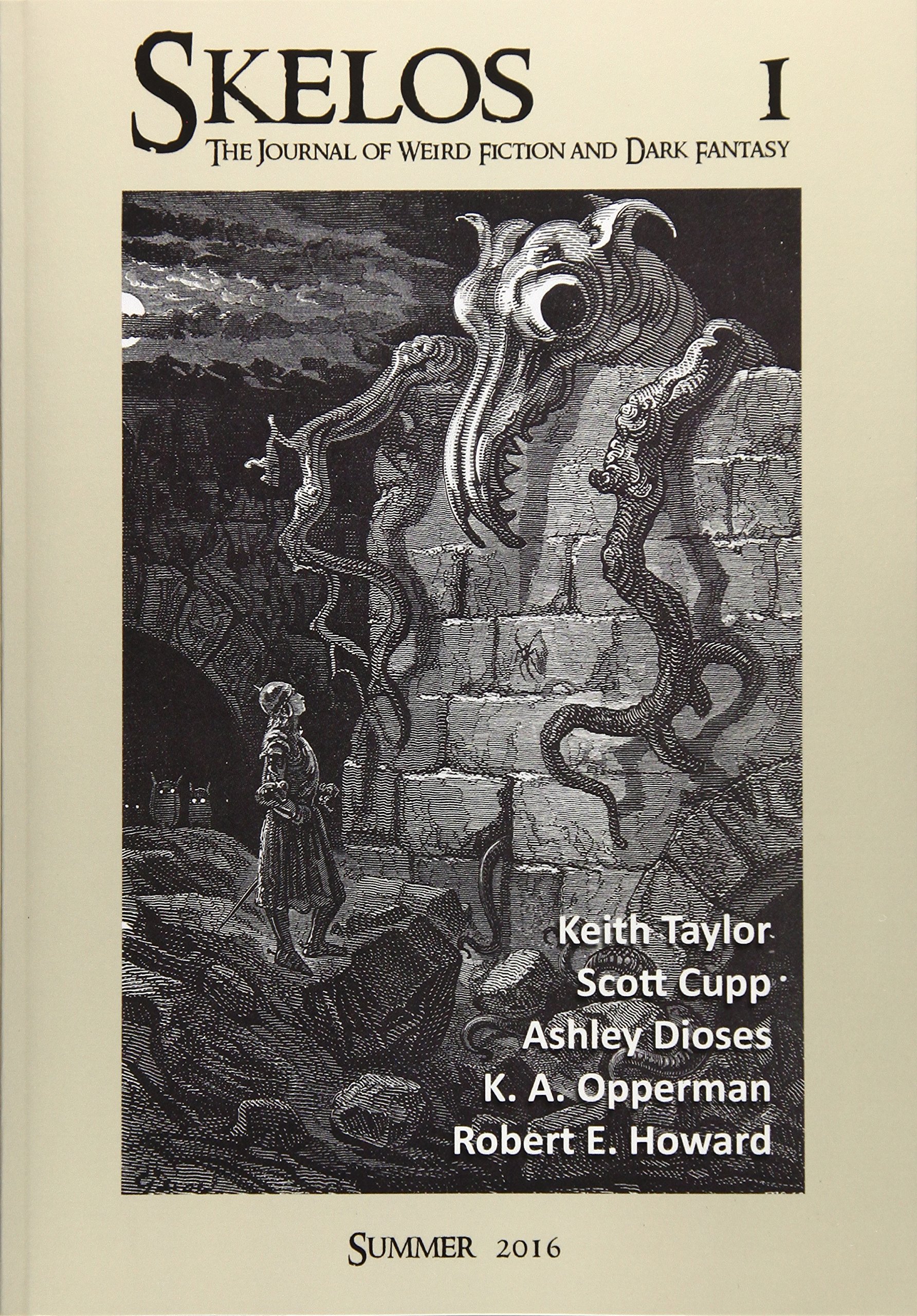
Skelos: The Journal of Weird Fiction and Dark Fantasy, Issue 1
Skelos Press (2016)
904 words

Skelos 1 opens with an editorial entitled "Skull Session." Here Mark Finn, one of the three editors, outlines the journal's mission and provides a definition of "weird fiction." Finn begins by invoking the classic pulp magazine Weird Tales and its "big three": H.P. Lovecraft, Robert E. Howard, and Clark Ashton Smith. From this, it becomes clear that the journal will include not only weird fiction in the Lovecraftian sense, but anything that could have found a place in that famous pulp magazine, including sword and sorcery, occult mysteries, and more. Finn also acknowledges developments in the genre since the heady days of the 1930s, nodding to the so-called "New Weird." The editors intend for Skelos to be situated between these two periods--open to fiction and scholarship of both the old and new weird, but also accepting works that push the genre forwards into the twenty-first century. Perhaps Skelos can be seen as part of a wider trend now encapsulated by such movements as the "New Edge Sword and Sorcery"?

One of the main draws of this issue is a previously unpublished story by sword and sorcery veteran author Keith Taylor. The medieval Irish setting of "The Drowned Dead Shape" will be familiar to those who have read Taylor's Bard series. The story recounts the unfortunate events that overtake a motley crew of reavers after an encounter with a monster. Taylor does a good job of juggling multiple perspectives and keeping the plot moving, despite it sometimes feeling arrested by flashbacks.

Another big draw is previously unpublished material from Robert E. Howard. In "Nameless Tribes: Anthropological World-Building in 'Men of the Shadows'," Jeffrey Shanks presents a fascinating insight into Howard's worldview and what shaped his ideas about anthropology and history. This essay is accompanied by drafts of "Nameless Tribes," an early world-building exercise by Howard. These are interesting because they resemble a prototype of Howard's famous essay "The Hyborian Age." This is a true highlight of the issue and a vital contribution to Howardian scholarship.

Another notable entry in this volume is Jason Ray Carney's "One Less Hand for the Shaping of Things." From the opening, the reader may expect a classic sword and sorcery tale framed by the interplay between intrigue and violence. Instead, "One Less Hand" becomes a rather different sort of weird tale that defies comparison: an intense and intimate exploration of a man's emotional encounter with the supernatural. This story drew me in with a slow-building narrative and lush description reminiscent of Clark Ashton Smith. By the end I was genuinely invested in the protagonist, Ayolo, and his relationships.

With "Grettir and the Draugr," Jeffrey Shanks provides a graphic retelling of the Icelander Grettir's encounter with an undead shepherd. Both narrative and illustrations (drawn by Samuel Dillon) are thrilling, demonstrating the debt sword and sorcery has to the Icelandic sagas. However, it was not clear whether this was a direct translation from Grettir's Saga or a looser adaptation. I would have appreciated some signalling here.

David Hardy's "The Yellow Death" is a story very much in the tradition of Edgar Allen Poe, both in terms of style and subject matter. It felt like it could have been written in the nineteenth century rather than the twenty-first. Yet Hardy finds his own voice in this gripping tale of the protagonist's descent into plague-induced madness. Hardy is a talented author, and I shall be seeking out more of his work.

In "A Sword-Edge Beauty as Keen as Blades: C.L. Moore and the Gender Dynamics of Sword and Sorcery," Nicole Emmelhainz uses Moore's "Black God's Kiss" to offer a riposte to the idea that sword and sorcery is an inherently masculine genre. She argues that the genre instead offers a space for the exploration of feminist ideas through stories that challenge traditional gender roles and dynamics. I agree with this bold claim, but hold the opinion that "Black God's Kiss" might not be the best demonstration of it. Jirel of Joiry certainly subverts traditional female characteristics, of which she displays almost none. Whether the plot of the story subverts traditional gender dynamics remains an open question. Nevertheless, Emmelhainz's central thesis here is more important than the example used to explore it. As the author admits, this essay is only a starting point for a wider exploration of feminist themes in sword and sorcery.  Further exploration of these themes will strengthen the genre and its scholarship.

Each of the entries in the journal is accompanied by at least one illustration, which, along with the cover image by Gustave Dorรฉ, serve to fire the reader's imagination. Poems also intersperse the journal, providing occasional breaks from the longer pieces. Finally, the journal closes with some useful reviews of related fiction and non-fiction.

The recurrence of barbarian-like protagonists in several of the stories (e.g., those by Taylor, Shanks, and Sullivan), stories that evoke Lovecraft and Poe (Hannan and Hardy respectively), and an exploration of Robert E. Howard's influences keeps Skelos rooted in the traditions of weird fiction. Meanwhile, contributions like those by Carney and Emmelhainz signal the journal's intention to break out of those traditions. The issue succeeds well in balancing the traditional with the novel. Furthermore, the balance between fiction and non-fiction (70% to 30% according to Finn's editorial) also felt right. While the contributions are, expectedly, a mixed bag, the quality tends towards the higher end, and I look forward to reading the following issues.

About the Reviewer: Ricky Broome is an aspiring historian with a PhD in early medieval history. He lives in the UK with his partner, their daughter, and two feline familiars, Lucifer and Loki. When not reading about things that happened a long time ago, he indulges in weird and fantastical fiction.

About Spiral Tower Reviews: The authors who maintain the pulp genres of sword and sorcery and cosmic horror merit support. Financial support is key but there are other ways the cash-strapped can show support: engaged reading and thoughtful analysis. Literary movements emerge through the interactions of editors, authors, publishers, and amateur literary journalists. Learn more about contributing your review here. We are happy to work with first time reviewers.

Previous Spiral Tower Reviews:

Tanith Lee is the Empress of Dreams, review by George Jacobs